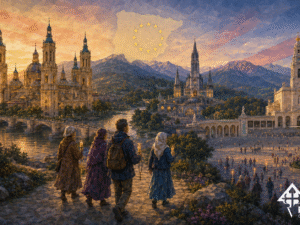


The Holy Chalice of Valencia
A Pilgrimage in the Footsteps of the Cup of the Last Supper
11 Days / 9 Nights | Madrid, Huesca, Jaca, San Juan de la Peña, Zaragoza, Teruel & Valencia
Follow the Journey of the Holy Chalice
At the heart of the Catholic faith stands the Eucharist.
On the night before His Passion, Jesus gathered with the Twelve, took bread and wine, gave thanks, and said:
“This is my body… this is my blood.”
According to an ancient and deeply rooted tradition, the chalice preserved today in the Cathedral of Valencia is associated with that very Last Supper.
For centuries, the Holy Chalice of Valencia — Santo Cáliz — has been venerated as the cup used by Christ when He instituted the Eucharist.
Its upper cup is an ancient agate vessel whose origins have been studied extensively, while Christian tradition traces its journey from Jerusalem through Rome and ultimately to Spain.
Popes St. John Paul II and Benedict XVI both celebrated Mass using the Holy Chalice during their visits to Valencia, underscoring its extraordinary devotional importance. Valencia was later granted a perpetual Jubilee celebration of the Holy Chalice, held every five years. The current cycle includes the 2025–2026 Jubilee.
This pilgrimage invites us to follow the tradition of that sacred relic across Spain.
From the lands of Aragón and the Pyrenees to the monasteries and churches that safeguarded the Chalice through centuries of political upheaval, we journey gradually toward its present home in Valencia Cathedral.
But this is not simply a search for the Holy Grail.
It is a pilgrimage toward the Eucharist.
Why Pilgrimage to the Holy Chalice?
The Holy Chalice invites us to return spiritually to the Upper Room.
Before the Cross, before the empty tomb, before Pentecost, there was the Last Supper.
Christ gathered His Apostles around the table.
He washed their feet.
He gave them the commandment of love.
And He instituted the Eucharist.
For Catholic pilgrims, the Chalice therefore points beyond itself.
It points toward Jesus Christ truly present in the Eucharist.
To stand before the Holy Chalice in Valencia is to contemplate the mystery Catholics celebrate at every Mass:
the same Christ who gave Himself to the Apostles continues to give Himself to His Church.
That gives this pilgrimage a clear spiritual theme:
From the Upper Room to the Altar.
From the Chalice to the Eucharist.
From memory to encounter.
The Tradition of the Holy Chalice
According to the tradition surrounding the relic, the Chalice left Jerusalem and became associated with St. Peter and the early Church in Rome.
During the persecutions of the 3rd century, tradition holds that St. Lawrence, the Roman deacon and martyr traditionally associated with Huesca, helped send the Chalice away from Rome for safekeeping.
From there, its history became connected with northern Spain.
Over the centuries, the relic is associated with places such as Huesca, the Pyrenean monasteries, Jaca and San Juan de la Peña.
The upheavals of medieval Spain meant that sacred treasures sometimes had to be moved from one secure place to another.
Eventually the Holy Chalice entered the possession of the Crown of Aragón.
In the 15th century it arrived in Valencia, where it remains today within a dedicated chapel of the Cathedral.
This journey through monasteries, kingdoms and generations of faithful Christians gives the pilgrimage an additional meaning:
the Eucharistic faith of the Church was preserved and handed on from generation to generation.
The Holy Chalice: Relic or “Holy Grail”?
The Holy Chalice of Valencia is often described popularly as the Holy Grail.
That language can attract attention, but for a Catholic pilgrimage I would place the emphasis elsewhere.
Legends of the Grail inspired centuries of medieval literature, knights and popular imagination.
But pilgrims do not come to Valencia in search of a legend.
They come to pray before a relic traditionally associated with the cup of the Last Supper.
That changes the meaning completely.
The real question is not:
“Did King Arthur search for this cup?”
The real question is:
“What happened when Christ took the cup into His hands?”
He gave thanks.
He gave it to His Apostles.
And He identified the wine with His Blood of the New Covenant.
For the Catholic pilgrim, that is the true mystery of the Holy Chalice.
St. John Paul II, Benedict XVI & the Holy Chalice
The modern history of the Chalice also includes remarkable papal moments.
Both St. John Paul II and Pope Benedict XVI celebrated the Eucharist using the Holy Chalice during visits to Valencia. Valencia’s official Jubilee material specifically highlights these papal celebrations as part of the relic’s contemporary spiritual significance.
For pilgrims, this provides a beautiful continuity.
The same relic traditionally associated with the Apostolic Church continues to stand beside the altar as the Church celebrates the Eucharist today.
Valencia: A Perpetual Jubilee City of the Holy Chalice
Valencia’s connection with the Holy Chalice is not merely historical.
The Holy See granted the city the privilege of celebrating a Holy Chalice Jubilee every five years.
The third Jubilee runs from October 30, 2025 through October 29, 2026, continuing the quinquennial cycle.
During Jubilee years, PGT can create special programs incorporating the official celebrations, sacramental opportunities and pilgrimage conditions established by the Archdiocese.
Outside Jubilee years, the Holy Chalice remains permanently available for veneration at Valencia Cathedral, making this an evergreen pilgrimage centered upon the Eucharist.
From the Upper Room to Valencia
The physical route of the Holy Chalice crosses kingdoms, mountains and centuries.
But spiritually the distance is much shorter.
It begins at a table.
Christ sits with His Apostles.
He takes the cup.
He gives thanks.
And He gives Himself.
Everything on this pilgrimage points us back to that moment.
Huesca reminds us of Christians who guarded their faith during persecution.
The Pyrenean monasteries remind us of communities that preserved sacred traditions through uncertain centuries.
San Juan de la Peña reminds us that the Church passes its treasures from one generation to the next.
And Valencia brings us before the Chalice itself.
But the pilgrimage does not truly end in the Cathedral.
It ends — and begins again — every time we return home and hear the priest at Mass proclaim:
“Take this, all of you, and drink from it…”
That is why we pilgrimage to the Holy Chalice.
Not simply to search for the Grail.
But to rediscover the Eucharist.
Pilgrimage Highlights
- Holy Chalice of Valencia — pray before the relic traditionally associated with the cup used by Christ at the Last Supper.
- Valencia Cathedral — experience the final destination of the route and the Chapel of the Holy Chalice.
- Eucharistic Spirituality — place the Last Supper, the Mass and the Real Presence of Christ at the center of the pilgrimage.
- St. Lawrence — encounter the tradition connecting the great Roman deacon and martyr with the preservation of the Chalice.
- Huesca — visit sites associated with St. Lawrence and the early Spanish tradition of the Chalice.
- San Pedro de Siresa — discover an ancient Pyrenean monastic site associated with the route.
- Jaca Cathedral — visit one of the great Romanesque cathedrals of Aragón.
- San Juan de la Peña — encounter the extraordinary monastery associated with the medieval preservation of the Chalice.
- Zaragoza — discover the capital of Aragón and the magnificent Basilica of Our Lady of the Pillar.
- Our Lady of the Pillar — pray at one of the most important Marian sanctuaries in Spain.
- Teruel — experience another beautiful historic city on the road toward Valencia.
- Holy Mass, Eucharistic Adoration and spiritual reflection may be incorporated throughout the pilgrimage.
- Holy Chalice Jubilee — special programs may be created during Valencia’s quinquennial Jubilee Years.
Important Information and Terms and Conditions
The published program is a general description and may be adjusted due to availability, operational requirements, local conditions, or the group’s needs. By registering, each traveler confirms that they have reviewed and accepted our Terms and Conditions.
Confirmed trip details, payment information, official meetings and presentations, updates, and final travel documentation will be provided through the official WeTravel page, the final itinerary, and other communications from Pilgrim Groups Travel. Travelers are responsible for reviewing all documents, insurance provisions, entry requirements, and travel instructions provided.
Proposed Itinerary
Day 1 — USA – Madrid
Our Pilgrimage Begins
At the appropriate time, we meet at our designated U.S. departure airport and begin our overnight transatlantic journey to Spain.
As we leave home, we begin preparing ourselves for a pilgrimage centered upon the mystery at the heart of Catholic life:
the Eucharist.
Overnight flight to Europe.
Day 2 — Arrival in Madrid
Welcome to Spain
Upon arrival at Madrid International Airport, we will be welcomed by our Pilgrim Groups Travel representative and accompanying guide and transferred to our hotel.
This first day is intentionally lighter following the international journey.
Depending on arrival time, we may enjoy an introductory panoramic visit of Madrid, celebrate our opening Holy Mass, or simply have time to rest and prepare spiritually for the pilgrimage ahead.
Welcome dinner and overnight.
Overnight: Madrid
Day 3 — Madrid – Huesca
St. Lawrence & the Journey of the Chalice
After breakfast, we depart Madrid and travel toward Huesca, where the Spanish tradition of the Holy Chalice becomes intimately connected with St. Lawrence.
St. Lawrence was one of the great deacons and martyrs of the Church of Rome.
According to the tradition surrounding the Chalice, during the persecution of Christians in Rome the sacred cup was entrusted for safekeeping and ultimately reached the land associated with Lawrence’s origins.
In Huesca, we may visit the Basilica of San Lorenzo, dedicated to the city’s patron saint, and San Pedro el Viejo, one of the most important Romanesque religious monuments in Aragón.
Time will be provided to explore the city’s Catholic heritage and reflect upon the courage of the early martyrs who protected the treasures and faith of the Church during times of persecution.
Dinner and overnight.
Overnight: Huesca
Day 4 — Huesca – San Pedro de Siresa – Santa Cruz de la Serós – Jaca
The Chalice in the Pyrenees
Today we travel into the dramatic landscapes of the Aragonese Pyrenees.
Our first principal visit will be San Pedro de Siresa, an ancient monastery whose history is associated with the medieval Christian communities of the region and with the traditional route followed by the Holy Chalice.
We then continue toward Santa Cruz de la Serós, where we may visit its beautiful Romanesque church and discover another important center of medieval Christian life.
Later, we arrive in Jaca.
Here we visit the magnificent Cathedral of San Pedro, one of the great landmarks of Romanesque architecture in Spain and a central church of the medieval Kingdom of Aragón.
According to the traditional route of the Chalice, Jaca forms an important chapter in the story of its preservation before its later transfer to other royal and monastic centers.
Subject to arrangements, Holy Mass may be celebrated during our visit.
Dinner and overnight.
Overnight: Jaca
Day 5 — Jaca – Bailo – Canfranc – Jaca
Faith in the Mountains
After breakfast, we continue exploring the Pyrenean route traditionally associated with the Holy Chalice.
Our journey may include Bailo, connected by tradition with one of the periods during which the Chalice was safeguarded in the region.
We then continue toward the spectacular mountain landscapes around Canfranc.
Depending on the final program, we may visit the famous historic Canfranc International Station, a striking monument to the role these valleys have played as a gateway between Spain and the rest of Europe.
The day allows us to appreciate the difficult geography through which medieval communities protected themselves, their churches and their sacred treasures.
Return to Jaca.
Dinner and overnight.
Overnight: Jaca
Day 6 — San Juan de la Peña
The Monastery of the Holy Chalice
Today we pilgrimage to one of the most extraordinary monasteries in Spain:
San Juan de la Peña.
Built dramatically beneath an immense rock overhang, the monastery became deeply connected with the medieval Kingdom of Aragón.
It also occupies a central place in the tradition surrounding the Holy Chalice.
Here, the relic appears in medieval documentary tradition before eventually passing into royal possession.
We will explore the monastery, its Romanesque cloister, royal pantheon and extraordinary mountain setting.
More importantly, we will reflect upon the generations of monks and Christians who safeguarded the faith and its sacred traditions within these remote mountains.
Subject to arrangements, time will be provided for Holy Mass or common prayer.
Return to Jaca.
Dinner and overnight.
Overnight: Jaca
Day 7 — Jaca – Aínsa – Zaragoza
From the Pyrenees to Aragón’s Capital
After breakfast, we leave Jaca and travel toward Aínsa, one of the most beautiful medieval towns in Aragón.
Time will be available to explore its historic streets and enjoy the extraordinary mountain setting.
We then continue toward Zaragoza, capital of Aragón and one of Spain’s great Catholic cities.
Arrival, dinner and overnight.
Overnight: Zaragoza
Day 8 — Zaragoza
Our Lady of the Pillar & the Royal History of the Chalice
Today we dedicate ourselves to Zaragoza.
Our principal spiritual visit will be the magnificent Basilica of Our Lady of the Pillar, one of the great Marian shrines of Spain.
According to ancient tradition, the Blessed Virgin Mary appeared here to St. James the Apostle while she was still living in Jerusalem, encouraging him in his mission of evangelization in Hispania.
We will have time for prayer and, subject to ecclesiastical arrangements, Holy Mass.
Our cultural exploration may also incorporate the Aljafería Palace, the extraordinary fortified palace associated with centuries of Islamic and later Christian royal history in Aragón.
Zaragoza also forms part of the later history of the Holy Chalice before its eventual arrival in Valencia.
Dinner and overnight.
Overnight: Zaragoza
Day 9 — Zaragoza – Teruel – Valencia
The Chalice Reaches Valencia
After breakfast, we continue south toward Teruel.
A brief guided visit may introduce us to its historic center and celebrated Mudéjar architecture.
We then continue toward Valencia.
Today our pilgrimage reaches its destination.
In the afternoon, we approach the Cathedral of Valencia, where the Holy Chalice has been venerated for centuries.
Within its dedicated chapel, we will finally stand before the relic whose journey we have followed across Spain.
This is intentionally not simply another sightseeing stop.
Time will be provided for prayer before the Holy Chalice.
Depending on ecclesiastical arrangements, we will seek the opportunity to celebrate or attend Holy Mass in the Cathedral, allowing the pilgrimage to culminate in the sacrament to which the Chalice itself points.
Dinner and overnight.
Overnight: Valencia
Day 10 — Valencia
The Holy Chalice & the Eucharistic Heart of the Pilgrimage
Today we remain in Valencia, allowing pilgrims to experience the Holy Chalice without rushing onward.
We will return to the Cathedral and explore its sacred and historical heritage in greater depth.
The Chapel of the Holy Chalice will remain the spiritual focus of the day.
For groups wishing for a more devotional program, possibilities may include Eucharistic Adoration, Holy Mass, a spiritual conference on the Last Supper and the Eucharist, personal prayer and participation in official Holy Chalice activities, subject to availability.
The day may also include some of Valencia’s principal cultural landmarks such as the Central Market, historic center, Serranos Towers, Plaza de la Virgen and other important sites.
Groups may also choose to explore Valencia’s special urban Holy Chalice route, which links sites around the city associated with the relic and its history. Valencia has developed this route as part of its Jubilee programming.
In the evening, we gather for our farewell dinner.
Overnight: Valencia
Day 11 — Valencia – USA
Return Home
After breakfast, at the appropriate time, transfer to Valencia Airport for our return journey to the United States.
Depending on airline schedules, the flight may connect through Madrid or another European gateway.
We return home after having followed the Holy Chalice through mountains, monasteries, cathedrals and kingdoms.
But the purpose of the journey was never simply to reach an object.
The Chalice has brought us back to the Upper Room.
Back to the words of Christ.
Back to the mystery celebrated at every altar:
“Do this in memory of me.”
Arrival in the United States and end of our pilgrimage services.
Lorem ipsum dolor sit amet, consectetur adipiscing elit, sed do
CUSTOMER NAME
Lorem ipsum dolor sit amet, consectetur adipiscing elit, sed do eiusmod tempor incididunt ut labore et dolore magna aliqua. Ut enim ad minim veniam, quis nostrud exercitation ullamco laboris nisi ut aliquip ex ea commodo consequat.
Lorem ipsum dolor sit amet, consectetur adipiscing elit, sed do eiusmod tempor incididunt ut labore et dolore magna aliqua. Ut enim ad minim veniam, quis nostrud exercitation ullamco laboris nisi ut aliquip ex ea commodo consequat.
Lorem ipsum dolor sit amet, consectetur adipiscing elit, sed do
CUSTOMER NAME
Lorem ipsum dolor sit amet, consectetur adipiscing elit, sed do eiusmod tempor incididunt ut labore et dolore magna aliqua. Ut enim ad minim veniam, quis nostrud exercitation ullamco laboris nisi ut aliquip ex ea commodo consequat.
Lorem ipsum dolor sit amet, consectetur adipiscing elit, sed do eiusmod tempor incididunt ut labore et dolore magna aliqua. Ut enim ad minim veniam, quis nostrud exercitation ullamco laboris nisi ut aliquip ex ea commodo consequat.
Lorem ipsum dolor sit amet, consectetur adipiscing elit, sed do
CUSTOMER NAME
Lorem ipsum dolor sit amet, consectetur adipiscing elit, sed do eiusmod tempor incididunt ut labore et dolore magna aliqua. Ut enim ad minim veniam, quis nostrud exercitation ullamco laboris nisi ut aliquip ex ea commodo consequat.
Lorem ipsum dolor sit amet, consectetur adipiscing elit, sed do eiusmod tempor incididunt ut labore et dolore magna aliqua. Ut enim ad minim veniam, quis nostrud exercitation ullamco laboris nisi ut aliquip ex ea commodo consequat.