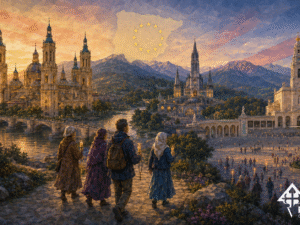


Caravaca de la Cruz & the True Cross
A Catholic Pilgrimage to One of Spain’s Great Jubilee Cities
7 Days / 5 Nights | Murcia, Caravaca de la Cruz, Lorca, Cartagena & More | Available for Parish and Catholic Groups
Pilgrimage to the City of the Cross
In southeastern Spain, surrounded by the landscapes of Murcia, stands one of the country’s most distinctive pilgrimage destinations: Caravaca de la Cruz.
For centuries, pilgrims have journeyed here to venerate the Santísima y Vera Cruz de Caravaca, a Lignum Crucis traditionally associated with the Cross of Christ and documented in the city since the Middle Ages.
Caravaca also possesses an extraordinary privilege.
The Holy See granted the sanctuary a Holy Jubilee Year in perpetuity, celebrated every seven years, making Caravaca one of the historic Catholic pilgrimage centers associated with this special Jubilee tradition.
Our journey is centered upon this sacred relic and the spirituality of the Cross, while also allowing pilgrims to discover the remarkable Catholic, cultural and historical heritage of the Region of Murcia.
We will visit Murcia and its magnificent Cathedral, pilgrimage to Caravaca, encounter Marian devotion in Yecla, explore historic Lorca and conclude in Cartagena, where Roman archaeology reminds us of the Mediterranean world into which Christianity was born.
Designed especially for parishes, Catholic organizations and faith-based groups traveling from the United States, this shorter pilgrimage offers an opportunity to encounter a part of Catholic Spain that remains largely undiscovered by international pilgrims.
Come to the Cross
At the heart of the Christian faith stands the Cross.
It is where Christ gave Himself completely for us. It is where suffering became sacrifice, death opened the way to eternal life, and an instrument of execution became forever the sign of our salvation.
In southeastern Spain lies a remarkable place where Christians have journeyed for centuries specifically to contemplate this mystery: Caravaca de la Cruz.
High above the medieval city, within the Basilica-Sanctuary of the Santísima y Vera Cruz, pilgrims come to venerate the Vera Cruz de Caravaca.
And what makes Caravaca extraordinary is what is contained inside its famous double-armed cross.
The Vera Cruz: a Lignum Crucis
The familiar double-armed Cross of Caravaca is actually the reliquary. Within it is preserved the sacred relic: a Lignum Crucis, traditionally held to be a fragment of the wood of the Cross upon which Jesus Christ was crucified. The official history of Caravaca describes it as an Eastern, patriarchal relic connected by tradition to Jerusalem and venerated in Caravaca since the 13th century.
This distinction is important.
The purpose of our pilgrimage is not simply to see the famous “Caravaca Cross” as an artistic or historical object.
We pilgrimage to Caravaca to draw near to the mystery of Calvary.
To stand before the Vera Cruz is to be invited to remember the Passion of Our Lord in a profoundly tangible way: His sacrifice, His wounds, His mercy, His forgiveness, and the love through which He redeemed the world.
For a Christian pilgrim, therefore, Caravaca is above all a place to return spiritually to the Cross.
“We adore you, O Christ, and we bless you, because by your Holy Cross you have redeemed the world.”
A Relic Venerated for Centuries
Devotion to the Vera Cruz has shaped Caravaca for nearly eight centuries.
According to the ancient tradition of Caravaca, the relic appeared miraculously during the celebration of Mass in the fortress in the 13th century.
The story tells of the Christian priest Ginés Pérez Chirinos, who was being held in territory then under Muslim rule. When asked to explain his priestly ministry, he answered that his vocation was to celebrate the Holy Mass.
A celebration was prepared.
But as the Mass began, the priest stopped: there was no crucifix upon the altar.
According to the tradition preserved in Caravaca, two angels appeared carrying the Cross and placed it upon the altar, allowing the priest to continue the Eucharistic celebration. The account further relates that what was witnessed led the Muslim ruler and members of his court to embrace Christianity.
Whether approaching Caravaca through its documented medieval history or through this centuries-old devotional tradition, the same reality becomes apparent:
the Cross has defined the spiritual identity of Caravaca for generations.
The relic was historically guarded first by the Order of the Temple and later by the Order of Santiago, while devotion to it eventually spread far beyond southeastern Spain.
Why Pilgrimage to Caravaca?
A pilgrimage is more than traveling to see something sacred.
It is a journey undertaken because we desire to encounter God differently from the way we do in ordinary life.
And Caravaca offers parishes a particularly powerful spiritual theme.
Here we can bring before the Cross our families, our suffering, our gratitude, our sins, our fears and the people for whom we have promised to pray.
We can contemplate Christ’s words:
“If anyone wishes to come after me, he must deny himself and take up his cross daily and follow me.” — Luke 9:23
The pilgrimage therefore becomes an invitation to ask ourselves:
What cross am I carrying?
Where is Christ asking me to trust Him?
Whom do I need to forgive?
What suffering do I need to place into His hands?
What part of my life still needs to be surrendered to Him?
And ultimately: Am I willing to follow Christ all the way to the Cross, trusting that the Cross never has the final word — because beyond it stands the Resurrection?
This is why we go to Caravaca.
Not simply to visit another beautiful Spanish sanctuary.
We go as pilgrims to the Cross of Christ.
Why Is Caravaca de la Cruz So Important?
Caravaca is not simply a town with an old church.
Its identity has been shaped by pilgrimage for centuries.
At the center of that tradition stands the Vera Cruz de Caravaca, a relic of the Lignum Crucis that has been documented in Caravaca since the 13th century.
The faith surrounding the relic attracted pilgrims from different parts of Europe, and Caravaca gradually developed into a significant Christian pilgrimage center.
The Holy See eventually granted the city the privilege of celebrating a Holy Jubilee Year in perpetuity every seven years.
For a Catholic pilgrim, this makes Caravaca especially meaningful.
The journey is centered not primarily around an apparition or the life of a saint, but around the Cross itself.
The instrument of the Passion.
The sign of Redemption.
And, for Christians, ultimately the sign of Christ’s victory over death.
The Cross at the Center of the Pilgrimage
The Cross can become so familiar to Christians that we sometimes forget the extraordinary claim it represents.
An instrument of execution became the central symbol of Christianity.
The object associated with defeat became a sign of victory.
The place of suffering became inseparable from the promise of Resurrection.
A pilgrimage to Caravaca therefore offers a natural opportunity to structure the spiritual life of the group around the Passion, sacrifice and saving love of Christ.
Parishes may choose to incorporate:
Stations of the Cross • Eucharistic Adoration • Confession • reflections on the Passion • Holy Mass • veneration of the Vera Cruz • spiritual conferences
according to the needs of the group and availability at the sanctuary.
Caravaca Beyond the Jubilee Year
Caravaca should not be thought of as a destination only during its Jubilee years.
The Vera Cruz remains at the heart of the sanctuary and pilgrimage tradition throughout the year, and the city continues to receive pilgrims outside the seven-year Jubilee cycle.
This makes the itinerary suitable as an evergreen Catholic pilgrimage product, while Jubilee years provide an especially important opportunity for parishes wishing to participate in the particular spiritual graces and celebrations associated with them.
Caravaca: A City of Pilgrims
Over the centuries, devotion to the Vera Cruz transformed this small Spanish city into a destination for pilgrims.
Popes granted privileges and indulgences connected with devotion to the relic, and Caravaca eventually received the extraordinary privilege of celebrating a Jubilee Year in perpetuity every seven years. The city’s official pilgrimage information today specifically invites visitors to come to the Basilica, venerate the Cross and, when applicable, fulfill the conditions associated with the Jubilee.
But Caravaca is not only a pilgrimage for Jubilee Years.
The Vera Cruz remains there.
The Cross remains there.
And the invitation of Christ remains the same: “Take up your cross and follow me.”
That makes Caravaca a powerful pilgrimage destination at any time of the year.
Pilgrimage Highlights
- Basilica-Sanctuary of the Vera Cruz — pilgrimage to the spiritual heart of Caravaca.
- The True Cross of Caravaca — venerate the Lignum Crucis traditionally associated with the Cross of Christ.
- Caravaca Jubilee Tradition — discover the city’s perpetual Holy Year, celebrated every seven years.
- Pilgrim Mass in Caravaca — possibility of participating in or arranging Holy Mass according to ecclesiastical schedules.
- The Spirituality of the Cross — place the Passion, Redemption and Resurrection of Christ at the center of the pilgrimage.
- Murcia Cathedral — discover the principal Catholic church of the regional capital.
- Francisco Salzillo — encounter one of Spain’s great traditions of sacred processional sculpture.
- Our Lady of the Castle in Yecla — discover an important local Marian devotion.
- Lorca — explore one of Murcia’s great historic cities and its Catholic heritage.
- Cartagena — experience the extraordinary Roman and Mediterranean history of southeastern Spain.
- Roman Theatre of Cartagena — discover the world of ancient Hispania and the cultural setting of the Early Church.
- Holy Mass, prayer and spiritual reflection can be incorporated throughout the journey.
Important Information and Terms and Conditions
The published program is a general description and may be adjusted due to availability, operational requirements, local conditions, or the group’s needs. By registering, each traveler confirms that they have reviewed and accepted our Terms and Conditions.
Confirmed trip details, payment information, official meetings and presentations, updates, and final travel documentation will be provided through the official WeTravel page, the final itinerary, and other communications from Pilgrim Groups Travel. Travelers are responsible for reviewing all documents, insurance provisions, entry requirements, and travel instructions provided.
Proposed Itinerary
Day 1 — USA – Madrid
Our Pilgrimage Begins
At the appropriate time, we will meet at our designated U.S. departure airport and board our overnight transatlantic flight to Madrid, Spain.
Meals and refreshments will be served according to the airline’s schedule.
Overnight flight to Europe.
Day 2 — Madrid – Yecla – Jumilla – Murcia
Welcome to Southeastern Spain
Upon arrival at Madrid International Airport, we will be welcomed by our Pilgrim Groups Travel representative and accompanying guide and board our private motorcoach.
Depending on the international flight schedule and final routing, we begin our journey toward southeastern Spain.
Our first visit may be Yecla, a historic town surrounded by the landscapes of northern Murcia.
Here we may visit the Sanctuary of Our Lady of the Castle, where the patroness of Yecla is venerated, and enjoy an introduction to the old town.
We continue toward Jumilla, a region known for its historic center, castle and centuries-old agricultural and winemaking traditions.
After our visit, we continue toward the city of Murcia.
Dinner and overnight.
Overnight: Murcia
Today’s visits will be adapted according to the group’s international flight arrival time.
Day 3 — Murcia – Mazarrón – Murcia
Catholic Murcia & the Mediterranean
After breakfast, we dedicate the morning to Murcia, capital of the region.
Accompanied by our local guide, we will explore its historic center, whose streets still preserve references to the guilds and trades that once shaped city life.
The principal religious visit will be the magnificent Cathedral of Murcia, a building that brings together Gothic, Renaissance and Baroque elements.
Subject to ecclesiastical arrangements, we may celebrate Holy Mass during our time in the city.
We may also visit the Salzillo Museum, home to important works by Francisco Salzillo, one of Spain’s great Baroque sculptors and a central figure in the country’s tradition of Holy Week processional imagery.
After lunch, we travel toward the coast and Mazarrón, where time may be available to enjoy the historic center, harbor and Mediterranean setting.
Return to Murcia.
Dinner and overnight.
Overnight: Murcia
Day 4 — Murcia – Caravaca de la Cruz – Mula – Murcia
The Vera Cruz of Caravaca
Today is the spiritual centerpiece of our pilgrimage.
After breakfast, we depart for Caravaca de la Cruz.
For centuries, Christian pilgrims have traveled to the city to venerate the Santísima y Vera Cruz, preserved within the sanctuary that dominates the old fortress above Caravaca.
The relic consists of fragments of wood traditionally identified with the Cross of Christ and preserved within the distinctive double-armed Cross of Caravaca.
We will visit the Basilica-Sanctuary of the Vera Cruz, learn about the history of the relic and the city’s pilgrimage tradition, and spend time in prayer.
Subject to the liturgical schedule and ecclesiastical arrangements, we may participate in a Pilgrim Mass or arrange the celebration of Holy Mass.
Caravaca’s spiritual importance is further emphasized by its Holy Jubilee Year in perpetuity, celebrated every seven years. The privilege was formally granted in the late 20th century, with the first recurring Jubilee under this system celebrated in 2003.
After lunch, we continue toward Mula, whose historic center preserves churches, traditional architecture and centuries of regional history.
Return to Murcia.
Dinner and overnight.
Overnight: Murcia
Day 5 — Murcia – Lorca – Totana – Murcia
Catholic Heritage of the Region of Murcia
After breakfast, we travel toward Lorca, one of southeastern Spain’s great historic cities.
Known for its rich Baroque heritage, Lorca preserves churches, palaces and remnants of its medieval fortifications.
Our visit may include the monumental Colegiata de San Patricio, together with historic streets, aristocratic residences and the old fortified areas of the city.
Subject to availability, additional religious sites connected with Lorca’s famous Holy Week traditions may also be incorporated.
After lunch, we continue to Totana.
Here we may visit the historic center and landmarks such as the Parish Church of Santiago, together with traditional streets and civic monuments.
For groups wishing for a stronger Marian dimension, the regional program may also be adapted to incorporate nearby sanctuaries or devotional sites.
Return to Murcia.
Dinner and overnight.
Overnight: Murcia
Day 6 — Murcia – Cartagena – Madrid
Ancient Carthago Nova & the World of Early Christianity
After breakfast, we depart for Cartagena, one of the most historically important Mediterranean cities in Spain.
Known in antiquity as Carthago Nova, Cartagena became a major Roman port and preserves an extraordinary archaeological heritage.
Our exploration may include the historic center, harbor and the remarkable Roman Theatre, one of the great archaeological discoveries of modern Spain.
The visit offers Catholic pilgrims an opportunity to better understand the urban and cultural world of the Roman Empire in which Christianity first spread around the Mediterranean.
Depending on current access conditions, we may also see the area of the Old Cathedral of Cartagena and other historic religious sites.
After lunch, we begin our journey toward Madrid.
Arrival and check-in at our hotel.
Depending on timing, a farewell dinner may be arranged.
Overnight: Madrid
Day 7 — Madrid – USA
Return Home
After breakfast, at the appropriate time, transfer to Madrid International Airport for our return flight to the United States.
We return home after a pilgrimage centered upon one of the most profound symbols of Christianity:
the Cross of Christ.
From Marian devotion in Yecla to the churches of Murcia, from the Vera Cruz in Caravaca to the Roman heritage of Cartagena, our journey has invited us to encounter faith across centuries of Spanish history.
Arrival in the United States and end of our pilgrimage services.
Lorem ipsum dolor sit amet, consectetur adipiscing elit, sed do
CUSTOMER NAME
Lorem ipsum dolor sit amet, consectetur adipiscing elit, sed do eiusmod tempor incididunt ut labore et dolore magna aliqua. Ut enim ad minim veniam, quis nostrud exercitation ullamco laboris nisi ut aliquip ex ea commodo consequat.
Lorem ipsum dolor sit amet, consectetur adipiscing elit, sed do eiusmod tempor incididunt ut labore et dolore magna aliqua. Ut enim ad minim veniam, quis nostrud exercitation ullamco laboris nisi ut aliquip ex ea commodo consequat.
Lorem ipsum dolor sit amet, consectetur adipiscing elit, sed do
CUSTOMER NAME
Lorem ipsum dolor sit amet, consectetur adipiscing elit, sed do eiusmod tempor incididunt ut labore et dolore magna aliqua. Ut enim ad minim veniam, quis nostrud exercitation ullamco laboris nisi ut aliquip ex ea commodo consequat.
Lorem ipsum dolor sit amet, consectetur adipiscing elit, sed do eiusmod tempor incididunt ut labore et dolore magna aliqua. Ut enim ad minim veniam, quis nostrud exercitation ullamco laboris nisi ut aliquip ex ea commodo consequat.
Lorem ipsum dolor sit amet, consectetur adipiscing elit, sed do
CUSTOMER NAME
Lorem ipsum dolor sit amet, consectetur adipiscing elit, sed do eiusmod tempor incididunt ut labore et dolore magna aliqua. Ut enim ad minim veniam, quis nostrud exercitation ullamco laboris nisi ut aliquip ex ea commodo consequat.
Lorem ipsum dolor sit amet, consectetur adipiscing elit, sed do eiusmod tempor incididunt ut labore et dolore magna aliqua. Ut enim ad minim veniam, quis nostrud exercitation ullamco laboris nisi ut aliquip ex ea commodo consequat.