


A Catholic Pilgrimage Through the Life, Vocation & Spiritual Legacy of the Founder of Opus Dei
9 Days / 7 Nights | Madrid · Burgos · Logroño · Pamplona · Barbastro · Torreciudad · Zaragoza
About This Pilgrimage
Follow the life and spiritual journey of St. Josemaría Escrivá, founder of Opus Dei, through the cities, churches and sanctuaries that shaped his vocation and mission.
Born in Barbastro in 1902, Josemaría experienced the beginnings of his priestly vocation in Logroño, prepared for the priesthood in Zaragoza, celebrated his first Mass before Our Lady of the Pillar, and later moved to Madrid, where on October 2, 1928, he received the inspiration that led to the foundation of Opus Dei.
This pilgrimage is much more than a biographical journey. It is an opportunity to encounter one of the central themes of St. Josemaría’s spirituality: that holiness is not reserved for a few, but can be sought in ordinary life — through our work, family, friendships and everyday responsibilities.
From his birthplace in Barbastro and the footprints in the snow that helped awaken his vocation, to the Basilica of Our Lady of the Pillar and the beginnings of Opus Dei in Madrid, we will discover the places behind his remarkable life.
The journey also takes us to Torreciudad, one of Spain’s great modern Marian shrines, and to Pamplona, where his vision of sanctifying professional and intellectual life took concrete form through the University of Navarra.
Pilgrimage Highlights
- Follow the life of St. Josemaría Escrivá across Spain
- Visit the places associated with the foundation and early years of Opus Dei in Madrid
- Discover Burgos, where St. Josemaría lived during the Spanish Civil War
- Visit Logroño and recall the famous footprints in the snow that influenced his vocational discernment
- Visit the church of Santiago el Real, connected with the Escrivá family
- Explore the University of Navarra in Pamplona
- Visit Barbastro, birthplace of St. Josemaría
- Discover his childhood home, school and family connections
- Visit the magnificent Cathedral of Barbastro
- Pilgrimage to the Sanctuary of Torreciudad
- Venerate Our Lady of Torreciudad
- Visit the Basilica of Our Lady of the Pillar in Zaragoza
- Discover the places associated with St. Josemaría’s seminary formation and priestly ordination
- Opportunity for daily Holy Mass and spiritual activities
- Private pilgrimage programs available for parishes, Opus Dei groups, schools, universities and Catholic organizations
Important Information and Terms and Conditions
The published program is a general description and may be adjusted due to availability, operational requirements, local conditions, or the group’s needs. By registering, each traveler confirms that they have reviewed and accepted our Terms and Conditions.
Confirmed trip details, payment information, official meetings and presentations, updates, and final travel documentation will be provided through the official WeTravel page, the final itinerary, and other communications from Pilgrim Groups Travel. Travelers are responsible for reviewing all documents, insurance provisions, entry requirements, and travel instructions provided.
Proposed Itinerary
Days 1 & 2 — USA – Madrid
Arrival in Spain
Departure from our designated U.S. airport aboard our overnight flight to Madrid.
Upon arrival, reception and transfer to our hotel. Time to rest following the international journey before gathering for our welcome dinner.
This evening provides our first opportunity to introduce the life and spirituality of St. Josemaría and prepare ourselves for the pilgrimage ahead.
Dinner and overnight in Madrid.
Day 3 — Madrid – Burgos
The Beginnings of Opus Dei
Our pilgrimage begins in Madrid, the city where St. Josemaría arrived as a young priest and where, on October 2, 1928, he understood the mission that would lead to the foundation of Opus Dei.
We will discover several places connected with these formative years and the early development of his apostolate, including sites associated with the Vincentians (Paúles) and the Church of Nuestra Señora de los Ángeles.
We will also visit the Almudena Cathedral, where a chapel is dedicated to St. Josemaría.
Throughout the visits, we will reflect upon the message that increasingly became central to his mission: the universal call to holiness and the sanctification of ordinary life and work.
After our visits, departure for Burgos.
Overnight in Burgos.
Day 4 — Burgos – Logroño – Pamplona
War, Vocation & the Footprints in the Snow
This morning we discover Burgos, where St. Josemaría lived during an important period of his life following his escape from the religious persecution taking place in Madrid during the Spanish Civil War.
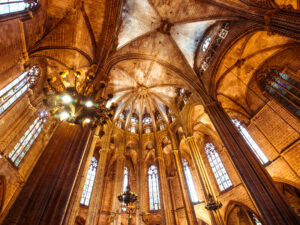
We will visit the magnificent Cathedral of Burgos and walk through the historic center and along the Arlanzón River, discovering places associated with his time here, including the Church of El Carmen and the Parish of San Cosme y San Damián.
We then continue to Logroño, one of the most important places for understanding St. Josemaría’s vocation.
Here, as a teenager, he encountered the footprints of a barefoot Carmelite friar in the snow. Seeing the sacrifice represented by those footprints made him wonder what God might be asking of him. The experience became an important moment in his discernment of a priestly vocation.
We will visit places connected with the Escrivá family, including Santiago el Real, their parish church, and the Co-Cathedral of Santa María de la Redonda.
Continuation to Pamplona.
Overnight in Pamplona.
Day 5 — Pamplona – Barbastro
Sanctifying Study, Work & Professional Life
Today we visit Pamplona and the University of Navarra, founded in 1952 under the inspiration of St. Josemaría.
The university provides an extraordinary opportunity to understand his teaching about the sanctification of professional work, intellectual life and ordinary human activity.
It was here in 1967 that St. Josemaría delivered his celebrated homily “Passionately Loving the World,” expressing with particular clarity his vision of encountering God in the circumstances of everyday life.
We will explore the campus and also visit the Bidasoa International Ecclesiastical College, according to availability and the final program.
After our visits, departure for Barbastro.
Overnight in Barbastro.
Day 6 — Barbastro
Birthplace & Childhood of St. Josemaría
Today is dedicated to Barbastro, where Josemaría Escrivá was born on January 9, 1902.
Walking through the city allows us to discover the family and religious environment in which his faith first developed.
We will see places associated with his childhood and family, including the area of his birthplace, the business connected with his father, Casa Albás, associated with his mother’s family, and the Piarist school where he studied before the family eventually moved to Logroño.
We will also visit Barbastro Cathedral and the Diocesan Museum.
Our program may include the Museum of the Claretian Martyrs, recalling the dramatic witness of the missionaries killed for their faith during the religious persecution of 1936.
We will also visit the Sanctuary of Our Lady of El Pueyo, overlooking the countryside surrounding Barbastro.
Overnight in Barbastro.
Day 7 — Barbastro – Torreciudad – Zaragoza
Our Lady of Torreciudad
Today we make one of the great Marian visits of our pilgrimage: the Sanctuary of Torreciudad.
St. Josemaría’s relationship with Our Lady of Torreciudad began in childhood. When he was approximately two years old, he became gravely ill. After his unexpected recovery, his mother took him to the old hermitage of Torreciudad in thanksgiving to the Blessed Virgin.
Decades later, St. Josemaría promoted the construction of the present sanctuary as a place dedicated particularly to Marian devotion, conversion and the Sacrament of Reconciliation.
We will visit the modern sanctuary and the historic hermitage associated with the centuries-old devotion to Our Lady of Torreciudad.
Time for prayer and, whenever possible, celebration of Holy Mass.
In the afternoon, departure for Zaragoza.
Overnight in Zaragoza.
Day 8 — Zaragoza – Madrid
Our Lady of the Pillar & St. Josemaría’s Priesthood
Our final major pilgrimage day takes us into the heart of Zaragoza, where Josemaría prepared for the priesthood.
We will visit the magnificent Basilica of Our Lady of the Pillar, one of the great Marian sanctuaries of Christianity.
During his years in Zaragoza, St. Josemaría frequently came here to pray before Our Lady. Following his priestly ordination in 1925, he celebrated his first solemn Mass in the Chapel of Our Lady of the Pillar.
For pilgrims following his life, this is therefore one of the most spiritually significant places on the entire route.
We will also discover the Cathedral of the Savior — La Seo and places associated with his years of priestly formation, including the Royal Seminary of San Carlos.
After time for prayer and our final visits, we return to Madrid.
Overnight in Madrid.
Day 9 — Madrid – USA
Return Home
After breakfast, transfer to Madrid Airport for our return flight to the United States.
We return home having followed St. Josemaría from his childhood in Barbastro through the awakening of his vocation, his priestly formation and the foundation of Opus Dei — but above all, having encountered his invitation to discover that ordinary life itself can become a path to holiness.
End of our pilgrimage services.
Related products

Sacred Relics
Other Routes
Marian Shrines